
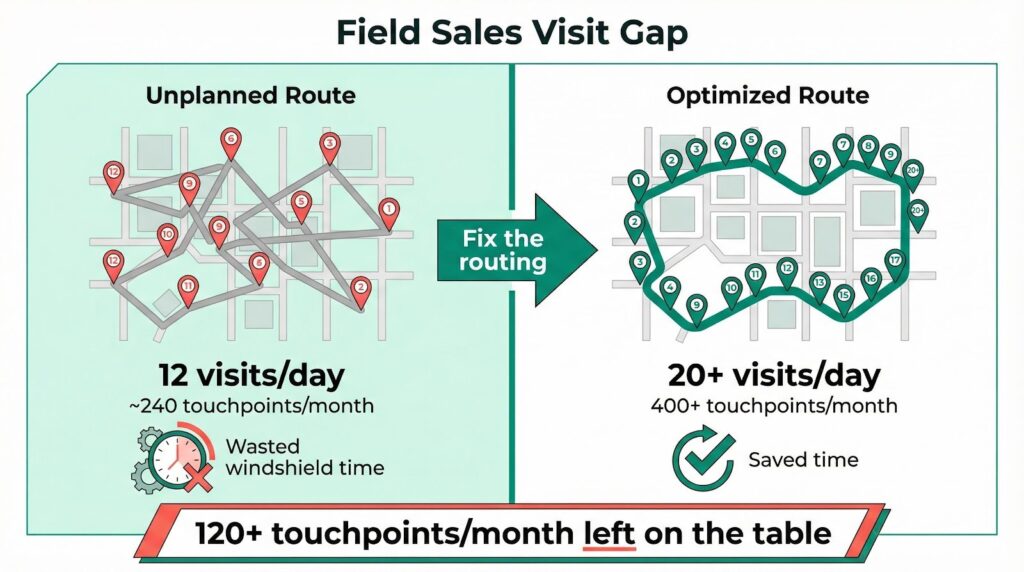
The difference between a 12-visit day and a 20-visit day is rarely about working harder. It is about how you plan your route. Most field sales reps lose one to three hours every day to backtracking and traffic they could have avoided. Fix the routing and you unlock capacity you did not know you had.
The Problem Is Not Your Work Ethic
You already know what windshield time costs you. Every minute driving is a minute you are not in front of a prospect. But the compounding effect is what kills.
A rep averaging 12 visits per day instead of 18 leaves roughly 120 potential touchpoints per month on the table. That gap shows up directly in pipeline and closed revenue. It is not a scheduling problem. It is a routing problem.
Then there is territory coverage. Without structured route planning, reps cluster visits around familiar accounts and neglect the edges. Prospects in those gaps go unvisited for weeks. Competitors fill the space.
What Your CRM and Google Maps Cannot Do
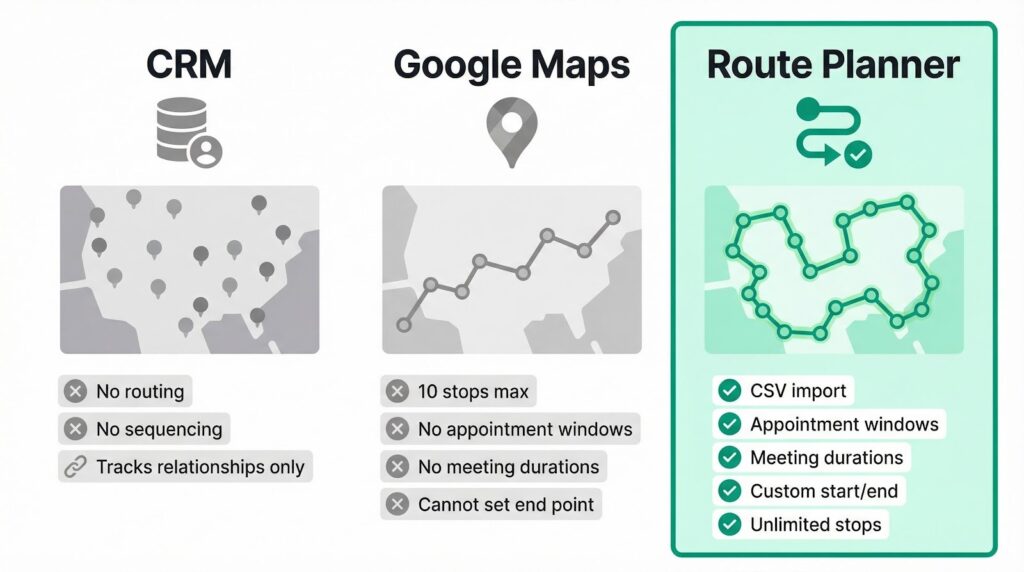
Your CRM knows where your accounts are. It cannot sequence them into an efficient driving order. It tracks relationships, not roads.
Google Maps caps out at about 10 stops and ignores appointment windows, meeting durations, and the fact that you need to end your day near home. It is a navigation tool, not a field sales route planner.
So you default to habit. Sort by zip code, guess at drive times, hope it works. When a meeting cancels or runs long, the whole schedule falls apart.
What a Route Planner Built for Field Sales Actually Does
The right tool takes your full list of visits and returns the fastest sequence that respects your constraints. Here is what that looks like in practice.
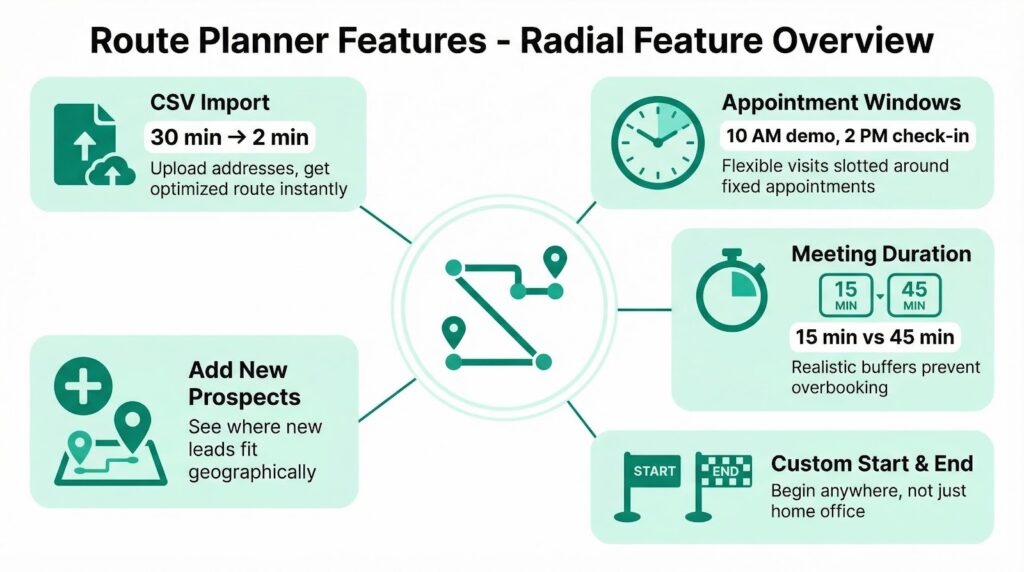
Accepts your CRM export directly. Export customer addresses as CSV, upload them, and get an optimized route back in seconds. No manual reordering. A good route planner turns a 30-minute planning session into a 2-minute upload.
Handles appointment windows. A 10 AM demo and a 2 PM check-in need different treatment. The tool should slot flexible visits around your fixed appointments automatically.
Accounts for meeting duration. A 15-minute check-in and a 45-minute demo require different buffers. Build realistic time estimates in so the tool plans around them instead of stacking appointments too tightly.
Sets custom start and end points. If your first meeting is on the west side of town, start there instead of your home office. Small adjustments to anchor points make a measurable difference in total drive time.
Fits new prospects into existing routes. When adding leads to your rotation, upload them alongside your regular stops to see where they fit geographically before committing to visit them.
Five Habits That Turn Good Routes Into Great Days
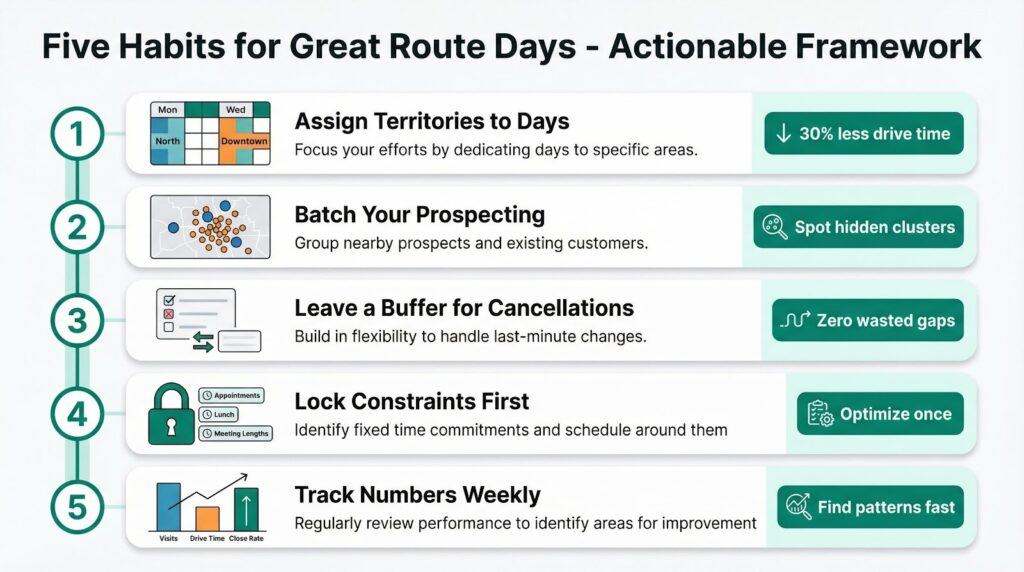
Assign territories to days. Give geographic zones specific days of the week. Monday is the north side. Wednesday is downtown. This alone can cut drive time by 30 percent because you stop crossing your entire territory daily.
Batch your prospecting. Use a route planner that accepts CSV uploads to plot new leads alongside existing accounts. You will spot clusters you would have missed eyeballing a map.
Leave a buffer for cancellations. Keep a short list of nearby low-priority stops you can slot in when a meeting falls through. You already know which accounts are closest to your current position.
Lock constraints before you optimize. Appointment times, meeting lengths, lunch break — set them first. Adjusting after the route is built means starting over.
Track the numbers weekly. Total visits, total drive time, close rate by territory. Patterns show up fast. Maybe your Thursday route always runs long because of school traffic. Shift those stops earlier and the problem disappears.
More Visits, More Pipeline, Same Hours
The reps who consistently hit 20+ visits per day are not superhuman. They stopped wasting time on routes they could optimize in minutes. The math is straightforward: more visits mean more conversations, more conversations mean more pipeline, more pipeline means more closed deals. The gap between reps who plan manually and reps who optimize compounds every single week.